Press releases are one of the simplest online marketing strategies a small business can implement to attract big business. A press release is written like an announcement and your writing style should be story-based, focused on delivering factual information (who, what, why, where and when).
Writing an Effective Press Release
The release should be written in third person with a style that strives to be newsworthy and catch the eye of potential customers. The main goal is to drive traffic to your website and add more links into your website. Building relevant links that point towards your website is called search engine optimization.
To get started with Press Releases, here is a simple 3 step process:
1. Identify press release topics
Compile a list of newsworthy stories. Some examples are:
a. New product launch or features
b. Signing a new strategic customer
c. Publishing a new Report or Book
d. Winning an award or breaking a record
e. Business owner speaking at a conference
2. Submit Press Releases
Halo Effects, LLC, an Arizona internet marketing firm, offers a press writing service and distribution. This solution is affordable for business owners who don’t want to take the time to write and publish a press release.
Schedule your releases so you have a constant stream of news flow. Submit the articles to a PR distribution service or manually submit to the various free online PR sites.
3. Measure lead generation
Paid PR sites will provide statistics on how many times your release has been viewed and which search engines driving the most traffic to your release. You will be able to determine which keywords are getting the most readers.
Email marketing is one of the simplest and effective ways to increase sales. There are some important things to consider when launching a successful campaign:
1. What is the goal of the email campaign?
Is it to invite people to an event or promote a new product? Is it a monthly newsletter? Or, is it part of a drip email campaign that is attempting to sell something? If you have another marketing strategy, then your email marketing should be integrated into the bigger plan.
Your subject line should lead the reader to open the email. Think about all the junk mail most people receive from businesses – it can be overwhelming and your email needs to stand above the crowd.
The body content of the email should be personalized and capture the features and benefits of whatever you are promoting. The most effect way to present the information is in an advertorial style:
Headline
Subheadline
Feature/Benefit Statement
Feature/Benefit Statement
Feature/Benefit Statement
Keep the small talk and drivel to a minimum and quickly steer the prospect towards the goal of the email campaign. Every email should have a single call to action that pushes the reader further down the campaign funnel. To improve response rates, use trust-based selling tactics instead of the hard sell. Offer the reader valuable information as often as possible.
2. Design
It is important to present the content of your email professionally, yet concisely, as possible. Integrate the look with your brand name and web site at the footer. Double check the grammar and spelling of the content.
Ensure the email can be opened by a variety of platforms, including plain text. HTML emails are more likely to get caught in spam filters and excessive links can raise the spam rating of the email. Test the images, margins and other potential formatting issues. Test all links supplied in the email.
3. Know the CAN-SPAM Act
The best email leads are acquired via a double opt-in which also ensures they comply with the CAN-SPAM act. A double opt-in requires prospects to verify their account and information before they are added to your list. Prospects and customers should always be able to opt out of your list at any time.
4. Retention
Keeping your repeat customers happy is important. If a customer complains, address the issue promptly. Keep your mailing list up to date and remove delinquent email addresses to avoid being labeled as spam. To retain audience attention, use customer participation tactics such as voting, updates, or expert information and rewards.
To learn more about email marketing services, contact Halo Effects, an Arizona internet marketing firm for a free assessment of your internet marketing plan.
Blogging for small business is the one of the easiest ways to generate traffic to your website if your content is relevant and valuable. A blog is short for “web log” and can be thought of as a journal. For example, you could write about your experiences as a financial planner and useful information you learn.
Unlike a news article, the content style and format are not critical. Blogging for small business can also trigger discussions and comments that further development the content. I’ve read several blogs that get first-page Google search rankings for Divorce Law, Real Estate, etc. These pages drive massive traffic and it’s completely free.
If you search for information on any local product or service, you’ll be sure to come across several blogs with relevant discussions. I like blogging because threads or strands of information can be provided without writing a long dissertation. The key to blogging is valuable content and high frequency.
Post things that are timely, relevant, useful and helpful
Getting someone to visit your blog is easy. Write a blog about a special interest, find a group related to your topic on one of the social networking sites (MySpace, Facebook) and post a comment about the blog and provide a link to it.
To drive more traffic to your blog (and potentially more leads), you can use niche keywords that will give your pages higher search engine rankings. The free blogging sites I recommend for newbies are Blogger.com and WordPress.com.
Most of the social networking sites also have blog functionality that can be utilized as well.
The easiest way to develop content for a blog is to look at what others are writing about and then re-write it. Google looks for unique content so be sure anything that is copy and pasted is 60% different in word and sentence structure.
Another simple way to discover blog topics is to ask your list. Have your customers ask the most burning questions they want answered. Each question can become the topic of a blog post.
The goal of blogging for small business is to drive traffic to your opt-in page, however, it cannot be forgotten that blogs can be viral – if done properly. By blogging consistently, you have the opportunity to position yourself as a trusted adviser and provide professional direction to the readers.
Blogs are a form of social media and readers can generate their own content by commenting below a blog post. As an author, you want to create discussions and promote commenting that automatically builds the page of information for you.
Quick tips on how to drive more traffic to your blog:
Monitor similar blogs to make sure that your content is fresh, different and better.
Post brief messages on other blogs that mention your own blog site.
Swap links with other blogs. When you see blogs whose visitors might also be interested in yours, contact the blogger and suggest swapping links so that both blogs have links to each other.
Give visitors an incentive to spread the word about your site. Reward the visitor who posts the best new information with special recognition on your site.
To learn how to start blogging for small business and create a thought leadership blog in your industry, contact Halo Effects, an Arizona internet marketing firm for a free consultation.
“However beautiful the strategy, you should occasionally look at the results.”
Winston Churchill
Traditional vs. Direct Response Advertising
In the small business world, traditional brand advertising doesn’t work.
Been there, done that.
I’ve discovered there are two kinds of advertising:
1. Traditional Advertising – these types of ads aim to build awareness for your company and aren’t much more than the information on your business card – Company Name, Logo and Contact Information.
Tip: You will never get a call from someone with this type of advertising.
These ads are done by big corporations that spend millions on advertising or small business owners that don’t know any better.
2. Direct Response Advertising – the goal of this type of advertising is to get a response from your target audience.
Advertising is a real estate game, the larger the ad, the higher the cost. Direct response ads can be the most cost-effective because they eliminate the corporate dribble and deliver a value proposition to your audience.
Here is the 4 part blueprint for an effective Direct Response Ad that could be used online (pay-per-click) or offline (print ad):
1. Headline –Broken Down? Need a Tow?
2. Subheadline – 24 Hour Emergency Towing
3. Make a Compelling Offer – Free Roadside Service for AAA Members
4. Provide a Response Mechanism – Call Toll Free 1-888-Need-Tow
Measure Everything
The only type of advertising you should be doing as a small business owner is direct response, not only because it is inexpensive but also because the response rate can be quickly measured.
Measuring the “rate of response” means you must understand the cost of each lead and ultimately the cost to acquire a customer.
For example, if my pay-per-click cost is $0.50 and I can convert 10% of the people who click through to paying customer, then I am paying $5 to acquire each customer.
100 clicks @ $0.50 per click = $50.00
10% buy out of 100 = 10 paying customers
$50.00 cost to acquire 10 customers = $5.00 per distributor
If the profit I make from each customer is greater than $5.00 then I have a positive return on my advertising investment.
Figuring in the lifetime value of the customer – how much additional business that customer may refer my business or how much more they may buy – then my profit gets much higher.
I hate losing money so I want to get the quickest feedback possible as to whether an ad will work or not. This means testing several different ads to measure which advertisement gets a higher response.
Why Online Advertising?
The internet is by far the best place to test advertising because the results are instantaneous and low cost.
Once I determine the best ad structure online, then I re-use it offline.
Without having a mechanism to measure the performance of an ad, you run the risk of wasting money and killing your profits.
To learn more about setting up effective online and offline marketing campaigns, contact Halo Effects, an Arizona internet marketing firm, for a free consultation.
A viral marketing campaign encourages people to voluntarily communicate your message to a plurality of others.
The awareness can be spread by word-of-mouth (slower) or accelerated by the network effects of the internet.
Most businesses rely on word-of-mouth and are often constrained by geographies. I find this mind boggling in the age of internet marketing.
Viral messages are typically thought of as funny emails, videos, texts or images, however, at a more sustainable level, they are becoming items of high value such as free information products, samples, software or trial services.
The Power of Free
The promise of the internet has always been a price of ‘free’ and online users expect to start a new relationship without paying for it.
Studies have shown that satisfied customers tell an average of three other people about products or services they like, and eleven people about a product or service they didn’t like.
By providing a valuable giveaway (ethical bribe), there is a higher likelihood of customer satisfaction and no financial risk in telling others. The “giveaway” becomes the cost of building an ongoing a relationship with a user and the opportunity to get a sale.
If the initial viral message creates the right motivation, it may exponentially spread to other users who also start a relationship with your business.
Although there is sometimes a cost to building the viral message components, they should support the consumption of your primary product or service and can be re-purposed in many ways to drive sales.
Here are the 3 key benefits of Viral Marketing:
1. Fast – At the speed of the internet
2. Consumer Driven – Penetrate targeted groups with similar interests
3. Free to the business owner – Spreads by network effects, not paid advertising
In the business world, viral marketing is the Holy Grail
A small seed can grow into a fast moving message that multiplies exponentially without additional cost.
One of my favorite viral marketing campaigns was Burger Kings’ “Subordinate Chicken”. It created a wildly entertaining experience for visitors and was laced with a bit of controversy…the perfect recipe for rapid awareness.
If we inspect the success factors of viral marketing campaigns, they can be broken into four key ingredients:
1. Access – The internet is the perfect medium for a viral marketing campaign. Things travel at the speed of light, cost per impression is essentially zero and the opportunity to provide a free experience for the user is possible. The campaign can be designed to have no barrier to entry.
2. Ease of transfer – Through email, communication and transfer of the virus is simple and rapid. Blogs and social networking sights increase the distribution points for the message.
3. Targeted “bait” – The value of the content is measured by the perception of the people subjected to the virus. If the bait being used is of high value, the more proud the user will be to pass it along to others in their network.
4. Favorable emotional response – A negative response can also create a viral effect, however, as learned by the “Subordinate Chicken” website, enough negative responses can stop the spread.
By including these key ingredients into the design of a viral marketing campaign, a very low cost sales message can be spread all over the world.
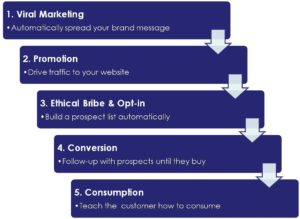
The design of a viral marketing campaign should cover the life-cycle of the relationship with the future client. This includes the initial viral message, an ethical bribe used to get permission to continue the relationship and ultimately converting the prospect into a paying customer.
Here is are the major steps in a viral marketing campaign that can be automated by building an online marketing system:
Anatomy of a Viral Marketing Campaign
To learn more about implementing a viral marketing campaign for your business, contact Halo Effects, an Arizona online marketing firm, for a free consultation.
“The Internet is so big, so powerful and pointless that for some people it is a complete substitute for life.”
Andrew Brown
Misconceptions about Online Marketing
The internet is an extremely valuable tool that can be used in many different ways…so many ways that it can be overwhelming.
Here are the most powerful ways to use online marketing for business owners:
1. As a marketing and advertising system – to generate leads
2. To automate a trust-based selling process
The mission of any business website is to generate sales. Most companies forget this primary mission. Some business sites have great content but there is rarely a way or a reason for the visitor to be sold.
With all the buzz about doing business online, offline promotion and sales is becoming a forgotten art.
There is a natural synergy between offline advertising and the internet.
Don’t get hung up on where you advertise – the audience you are reaching and the marketing message are most important.
The response mechanism can direct the audience to a web page or a telephone number. The same ad could appear on a road sign, in the newspaper classified section or on the back of your business card.
Here’s the key – your offline marketing should drive people online where they become part of an automated sales process.
Tip: The internet acts as a natural filter by eliminating people that don’t have access to a computer. In certain businesses filtering out prospects that can’t afford a computer or don’t know how to use the technology may be beneficial to your campaign.
Social networking sites have made getting your message out to like-minded people faster and cheaper than ever before. They provide free marketing by leveraging the power of groups and friends. You can use site-builders to add video, pictures, text, links and hosting is free. These sites can be set-up as communication and traffic funnels to your primary business website and are also a component of effective search engine optimization.
Here is a list of social networking sites that your company should be visible on:
My Space
Most famous in the U.S. but not heavily adopted internationally, it is dominated by Generation-Y users and began with an emphasis on music. The site allows you to create your own website, blog, post bulletins and send messages to “friends” that you collect in your network.
Twitter
Known as today’s water cooler, Twitter works like a group chat to share “what you are doing” with connected friends and family. With diligence, you can create a following of people who are interested in what you are working on.
Facebook
More complex than Twitter and a more mature audience than MySpace, Facebook allows you to create a personal website, share and connect with like-minded people.
Digg
Digg is a place for people to discover and share content from anywhere on the web. The shared content turns into a conversation and allows people to vote on an idea or comment you post.
Squidoo
Squidoo allows you to make and share “lenses” which are web pages anyone can create on topics they care about. You can earn income by creating links to ecommerce sites such as Ebay and Amazon. A lens gets shared between groups and you can promote your site to other Squidoo users. Squidoo sites are also considered “authority” sites by the major search engines so it’s possible to reach high search rankings (first page of Google) if you use the right keywords in the title and lens description.
Here are some valuable tips for making Social Networking Sites effective response sites:
Don’t overcrowd the site or use fancy graphics. Less is more. This is the biggest mistake I see online marketers make on these sites…too many videos, too many pictures and too many graphics.
Make the focal point of your site a single video or text offer that directs a visitor to an opt-in site for an ethical bribe.
Allow people to look at 1 thing, not 50. If they have more than one choice, they won’t make any.
Make it a business site, not a personal site that has a bunch of your friends making inappropriate comments. Don’t directly sell your business but rather tell your story.
Only invite others from your target market to become your ‘friends’. It’s best to invite people who have similar interests or background because they will be most likely to connect with you.
Let people get to know you. People don’t want to be sold something outright, build relationships first and then offer an ethical bribe to bring a prospect closer to what you are selling.
An online lead system can be developed so small and medium sized companies can use the internet to automate their prospecting and conversion process.
Companies grow by increasing the number of potential customers, retaining customers and getting referrals. In this article, we are going to focus on getting a lead or prospect to contact your business.
Every business would like to generate leads that consist of people who have a high propensity to buy your product or service. With print ads it is sometimes difficult to target an audience. Online, targeting can be accomplished by geography, behavior and demographics by using search engine marketing.
Millions of people are searching the internet everyday and it’s possible that thousands are looking for information on your product and services. The most typical way consumers look for things is by using a search engine like Google or Yahoo. When someone types in a search query, the search engine returns the most relevant information available on the internet. The search engine companies gives businesses the chance to advertise in areas surrounding the natural search results. The paid advertisements or listings can drive a prospect to your website when they click on your ad.
PPC or pay per click advertising is one of the advertising tools that allows a business owner to pay only when a prospect likes your ad enough to click on it an get the information your are promoting. PPC ads can be placed on both the search results pages and also on targeted websites that are related to your product or service. The campaign can be managed effectively by split testing ads, website pages the prospects visit and where they appear in ad listings. Budgets can also be controlled by placing spending limits per click and per day.
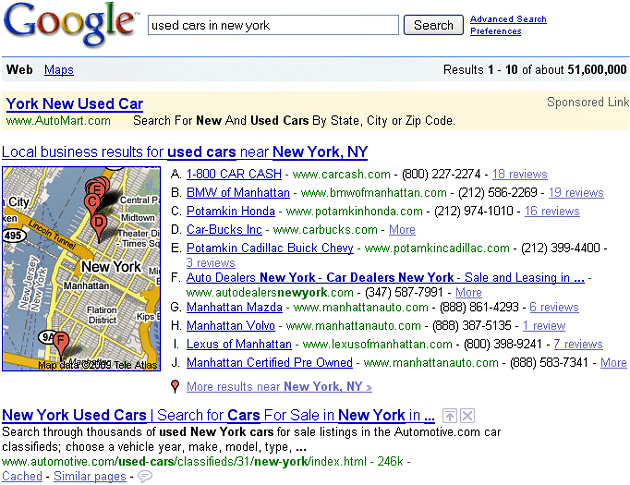
Google Local Listing Advertisement
Local search listings are available for brick and mortar businesses to advertise in their local community. Both Google and Yahoo allow businesses to list their business for free in a directory based on the location and category of business. Google gives up the top of the natural search results to the local listing service, making it very attractive real estate.
When setting up your advertising campaign, it is imperative to consider what a prospect may type into the search engine if they were looking for your product or service. If your advertisement or search phrases are too broad, the ad will be ineffective and the search engine will increase the price of your advertisement. Google, the most used search engine on the planet, rates the click through rate of your ad, the quality of your website as it relates to the search term and the conversion rate on your website. If the scores remain high, Google will continue to show your ad at a lower cost.
To generate a lead, a business can provide several different methods of contact on their website. This can be accomplished by telephone, live chat, email or by having the prospect fill out a contact form. The trick to cost effective advertising is to decrease the cost of generating a lead. When a prospect clicks on your ad, the page they land on, also known as a landing page, should provide the information promised in the ad and then persuade them enough to contact your company or complete a sale. The landing page should be optimized for the target audience and feature specific keywords or phrases for indexing by search engines. The goal of the page is to motivate the prospect to take another step – fill out a contact form, call a telephone number or make a purchase.
Turning a new lead into a sale is part of a conversion process that should be mapped out, tested and refined as part of the overall campaign. To learn more about search engine marketing and how your company can set up it’s own online lead system, contact Halo Effects, an Arizona internet marketing company.
You may have heard the term “SEO” which is an acronym for Search Engine Optimization. By ‘optimizing’ your social media sites, Social Networking sites, blog posts, videos and articles you have a chance of ranking higher (first pages) on search engines like Yahoo and Google.
In 2007, Google accounted for 70% of all search traffic in the United States.
Search Engine Optimization is a science in itself and is a constant battle to maintain a high ranking and drive free traffic to your website. A sneaky way of avoiding the competition is to build a strategy for stealing all of the traffic that no one is paying attention to. That is how the little fish competes with the big fish.
The most popular search terms are very competitive and it’s very difficult to achieve high rankings if you use them in the titles and bodies of your website content.
Living in the Long Tail
To put this into perspective, let’s use a real world example. Let’s imagine you want to search for the term “Carpet Cleaning” in Google.
Example Search Term: “Carpet Cleaning”
The term “Carpet Cleaning” has been searched for 1,500,000 times in the past 30 days…on Google alone. Yahoo search volume is typically less than half that of Google.
There are over 5,000,000 websites that contain the exact phrase ”Carpet Cleaning”. Trying to compete on the search engines with a new website would be futile – there are too many strong competitors! Our approach is going to fly under the radar. We do this by looking at keywords phrases called “Long Tail Keywords” that include the word “Carpet Cleaning”.
Example Long Tail Keyword: “Phoenix Carpet Cleaning”
This keyword phrase was only searched for 2,900 times in the past 30 days, however, it only appears on 8000 websites. With those statistics we have a much better shot at getting our web content on the first page of the search engines.
In order to drive serious traffic using these little known Long Tail Keywords, we must collect 15-20 and integrate them into our web content. This means using them in our blogs, articles and videos.
Best practice teaches to use the exact Long Tail Keyword phrase in the title of the blog, article or video and then use it 3 times in the body.
The other half of the traffic equation is how many other websites view your site as having relevant information. The search engines believe a website is more “relevant” when other sites add your link to their site.
More links = Higher Search Ranking
Having more links will not only yield more traffic to your website but will also push your website higher on the search engine ranking page.
There are several strategies for doing this. You can ask other website owners to cross link, you put their link on your site and vice versa. Or, you can use the other free websites described in this chapter to point back to a central website.
I recommend the central website be a blog because it is the most familiar way to start a community/relationship site.
To learn more about search engine optimization and how your business can benefit, contact Halo Effects, an Arizona internet marketing firm for a free assessment of your website.